New ‘Project Sunrise’ megaflight almost breaks world record before maiden voyage | World | News
Flightradar24 has confirmed that a test flight of a huge new airbus became the second most tracked flight ever, losing the first-lace crown to Queen Elizabeth II’s last ever flight, with the plane carrying her coffin from Edinburgh to London back in 2022.
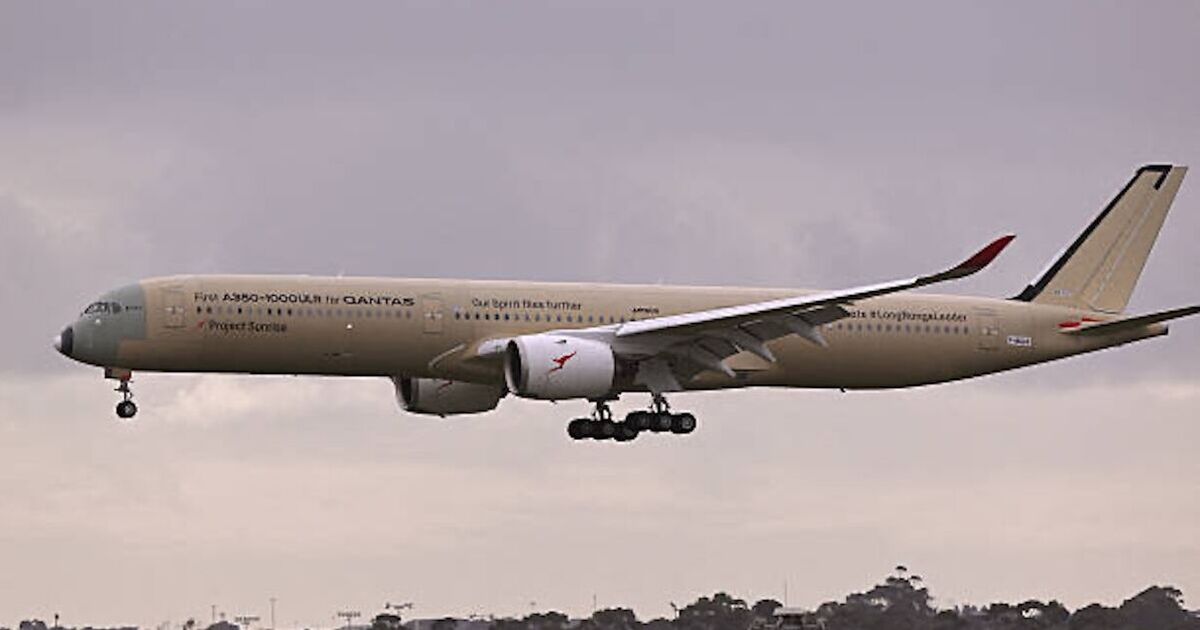
Qantas’ revolutionary new aircraft, designed to connect the UK and Australia without a stopover, made history after completing a gargantuan test flight following a marathon 10,500-mile (17,000km) journey from the Airbus factory in Toulouse, France. It took off last Thursday (July 23) at 7.33am local time and touched down in Melbourne, Australia on Friday (July 24) 19 hours and 12 minutes later.
A total of 75,000 people watched it land live on Friday on flight tracker Flightradar24, with the flight tracking platform reporting a massive 2,972,670 total views over the 19-hour trip.
Built specifically for Australian flag carrier Qantas and its ambitious “Project Sunrise”, the ultra-long-range jet is designed to finally link London and Sydney with direct, non-stop flights starting in October 2027. The aircraft features a specialised rear fuel tank carrying an extra 20,000 litres, giving it the incredible capability to stay airborne for up to 22 hours continuously.
Four Airbus pilots and five test engineers were on board to monitor the aircraft’s systems during the 19-hour and 13-minute delivery journey.
The second-most tracked flight in history has begun its return journey back to Europe, but not before becoming the most-watched fight on Monday with more than 10,000 people watching on as the jet went wheels-up.
The Airbus A350-1000ULR – custom-built for Qantas to fly non-stop between Sydney and London from October 2027 – took off on its first journey to Australia last week. Now it is on its way back, with an expected block time of 23 hours. Block time is marked from when the aircraft first moves away from the departure gate until it comes to a full halt at the destination terminal, complete with chocks on.
The Qantas jet began its return flight just before 5.30pm on Monday (July 27) and will again test one of the longest commercial routes possible with the aircraft.
While non-stop flights between the UK and Australia usually head east, Qantas revealed it would instead fly over the North Pole in its newest non-stop route. During the Northern Hemisphere’s winter, roughly 20% of flights will head north over Alaska, Greenland and Iceland before descending into London. By taking advantage of favourable tailwinds and lighter air traffic, this alternative route will cut total travel time down to between 19 hours 25 minutes and 20 hours 55 minutes, depending on conditions.
Crossing up to 11 time zones presents a major challenge for passenger body clocks. To combat extreme jet lag, Qantas partnered with the University of Sydney sleep experts to redesign the entire in-flight experience. This includes keeping the cabin dark for a full 12 hours, helping passengers sleep naturally despite the rapid time-zone shift.
The aircraft also features 12 circadian lighting scenes, including simulated sunsets, to help the body clock adapt. Meals are strategically timed – with low-fat, high-protein options before rest and alertness-boosting spices upon waking. Passengers can also use a dedicated wellbeing zone between Economy and Premium Economy to stretch and follow guided exercises throughout the record-breaking journey.
Before Project Sunrise launches to passengers in 2027, the world’s longest commercial flight remains Singapore Airlines SQ23/SQ24 between Singapore and New York. Covering 9,537 miles (15,349 km) on an Airbus A350-900ULR, the non-stop trek takes nearly 19 hours. Qantas’ new route will soon shatter both records, stretching an extra 1,000 miles to 10,500 miles and pushing flight times up to 21 hours.