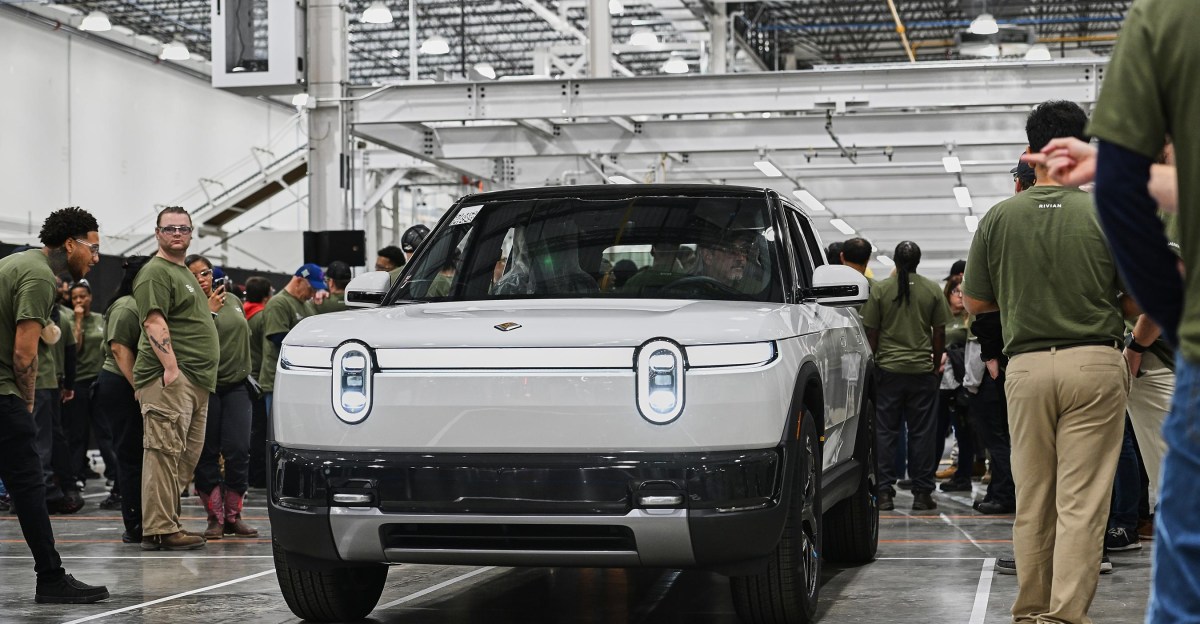
Rivian’s R2 is officially its best-selling vehicle
Rivian reported its third quarter earnings of 2026, providing us a closer look at the company’s financial health as it ramps up production of its all-important R2 electric vehicle — which is now, for the first time, outselling all of Rivian’s other EVs.
Rivian said it brought in $2.155 billion in revenue, a 38 percent increase compared to the $1.558 billion in Q3 2025. Of that amount, $1.55 billion came from automotive revenue, which is up 36 percent year over year. Comparatively, the company reported $605 million from software and subscription services, a 45 percent increase year over year. As EV sales slow down, the company is seeking to make more money from its digital products, including the Autonomy Plus package.
Automotive gross profits were on an upward trajectory, a sign that the company’s finances were improving as it delivered more vehicles. Rivian made $176 million in gross profit this quarter, a $152 million improvement compared to the same time last year. The company still lost $80 million in Q3 automotive gross profits, which is much better than the $130 million loss a year ago.
In other words, Rivian is losing less than it did a year ago because they sold more cars and made more money per vehicle. (Also, the company continued to sell pollution credits to other carmakers, and also received a tariff refund from the government — all of which was recorded as revenue.)
Rivian is losing less than it did a year ago because they sold more cars and made more money per vehicle.
Rivian brought in $256 million in profit in software and services, up $102 million from last year, with a strong 42 percent profit margin. Most of this cash came from licensing their tech to Volkswagen, alongside customer subscriptions for Rivian’s Autonomy Plus driving features. In many ways, Rivian’s tech partnership with Volkswagen and software sales are currently paying the bills, keeping the company profitable overall while it absorbs a lot of heavy upfront costs from launching the R2.
Earlier this month, Rivian reported a record sales quarter, with 19,751 vehicles produced and 19,248 delivered. That represents an 85 percent year-over-year increase in production and a 45 percent jump in deliveries. (For a direct-to-consumer automaker like Rivian, deliveries serve as a proxy for sales.)
Rivian doesn’t break down sales by model, so we don’t exactly how many R2s have reached customers so far. But the company said that the R2 is now the “best-selling Rivian vehicle by volume,” outselling the R1T and R1S, as well as the Electric Delivery Van (EDV).
“We had great results with R2 becoming our best selling vehicle by volume in the third quarter,” Rivian CEO RJ Scaringe said in a statement, ahead of the company’s earnings call this afternoon. “Customer and media feedback on R2 has been exceptional.”
The R2 was designed from the ground up to be Rivian’s higher-volume, mass-market offering — and by overtaking the company’s more expensive, lower-volume legacy vehicles, it seems to be doing just that. Still, the R2 isn’t bringing in the bulk of the revenue yet, as indicated by Rivian’s use of the phrase “by volume.” Most of the money is still coming from the VW partnership and its software division.
But that could change once Rivian starts shipping the more affordable versions of the R2, like the $55,485 Premium trim (coming in late 2026), the $49,985 Standard Long-Range (early 2027), and the $46,495 Standard (late 2027).