Russia economy meltdown as industry demands ‘major bailouts’ – £190m loss | World | News

Russia’s biggest lender is haemorrhaging hundreds of millions of dollars (Image: Getty)
Russia is facing mounting fears of a full-blown banking crisis after its key war lender suffered heavy losses, fuelling warnings that industries may soon demand sweeping state bailouts. Promsvyazbank (PSB), the biggest lender to defence firms backing Vladimir Putin’s war effort, has recorded a 19.2 billion ruble (£190million) loss last year after the bank was forced to set aside a staggering 300 billion rubles to cover souring loans.
The sharp reversal marks a dramatic shift for a lender, which had previously thrived by bankrolling the Kremlin’s military-industrial expansion. Analysts have now warned that the losses may be an early sign of deeper cracks spreading across Russia’s finances. Since the invasion of Ukraine, the Kremlin has pumped vast sums through state-backed banks into companies, particularly in the defence sector, helping sustain growth and creating what some economists describe as an illusion of resilience. However, that borrowing boom is now turning into a weakness.
READ MORE: Russia fires missiles near Chernobyl as threatening horror nuclear disaster
READ MORE: NATO fighter jets scrambled after Russian planes ‘violate’ airspace

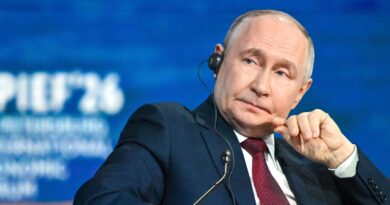
Russia is ‘formally under the criteria of a banking crisis’ said exiled opposition politician Vladimir Milov (Image: Getty)
“We are already formally under the criteria of a banking crisis. The only thing that is missing is a bank run,” said Vladimir Milov, an exiled opposition politician who was formerly a deputy energy minister under Putin, according to The Telegraph.
According to Russian central bank data, banking sector profits fell by 55% to 176 billion rubles (£1.7billion) in December, with Moscow Credit Bank, another major lender tied to the state oil giant Rosneft, also reporting a loss in the final quarter of 2025 as it grappled with a surge in loan defaults.
At the start of February, the Centre for Macroeconomic Analysis and Short-term Forecasting (CMASF), a think tank aligned with the Kremlin, published a report stating that a “banking crisis has now been confirmed,” which, based on its own definition, means that more than a tenth of banks’ loan books are unlikely to be repaid.

To fund Putin’s war in Ukraine, the Kremlin has been injecting massive amounts of cash into Russian companies through its banks (Image: Getty)
To cover its war costs over the course of the now over four-year war in Ukraine, the Kremlin has been injecting massive amounts of cash into Russian companies through its banks. This, according to Craig Kennedy, from the Harvard Davis Center for Russian and Eurasian studies, has fuelled economic growth and created an illusion of Russian resilience.
“This has created a large pool of opaque, unmeasured and poorly managed default risk at the heart of the Russian banking system,” the former vice chairman at Bank of America Merrill Lynch warned in his Substack, Navigating Russia.
Loans to defence companies alone have surged to more than $200billion (£2billion), accounting for nearly a quarter of all corporate lending – despite the sector’s historically weak credit record. According to Mr Milov, PSB’s losses reflect “deep troubles in the Russian military industrial sector”.

Russia’s high oil and gas prices thanks to the Iran war are providing a lifeline (Image: Getty)
The fallout is already spreading beyond the military sector. Three-quarters of Russian industries are now either struggling or stagnating, with key sectors such as coal, steel, paper and construction facing acute pressure. Consumer lending has also swung from strong growth to contraction, with central bank data showing this shrank by -0.7% in 2025 – a stark shift from the 11.3% growth recorded in the previous year.
Putin himself revealed that Russian GDP had contracted by 1.8% in January and February compared to the same period last year. In March, the Russian leader then told his country’s oil and gas companies that they should use windfall oil profits triggered by the war in Iran “to reduce their debt burden and pay off their debt to domestic banks”.
For now, Russia’s economy is surviving on the fact that soaring oil and gas prices are bringing in higher revenues for Russia’s energy giants since the war broke out in the Middle East. This, some economists have predicted, will help the Kremlin avoid a recession in the second half of this year.
However, if Donald Trump manages to secure a peace deal with Iran and the global energy crisis subsides, a resultant drop in energy prices could rapidly expose the scale of the problem, forcing the Kremlin to step in with costly bailouts for banks and state-backed companies. Estimates suggest such a rescue could run to 10% to 20% of GDP in a worst-case scenario.