Scientist carries her own severed scalp 200m after accident – ‘Soaked in blood’ | World | News

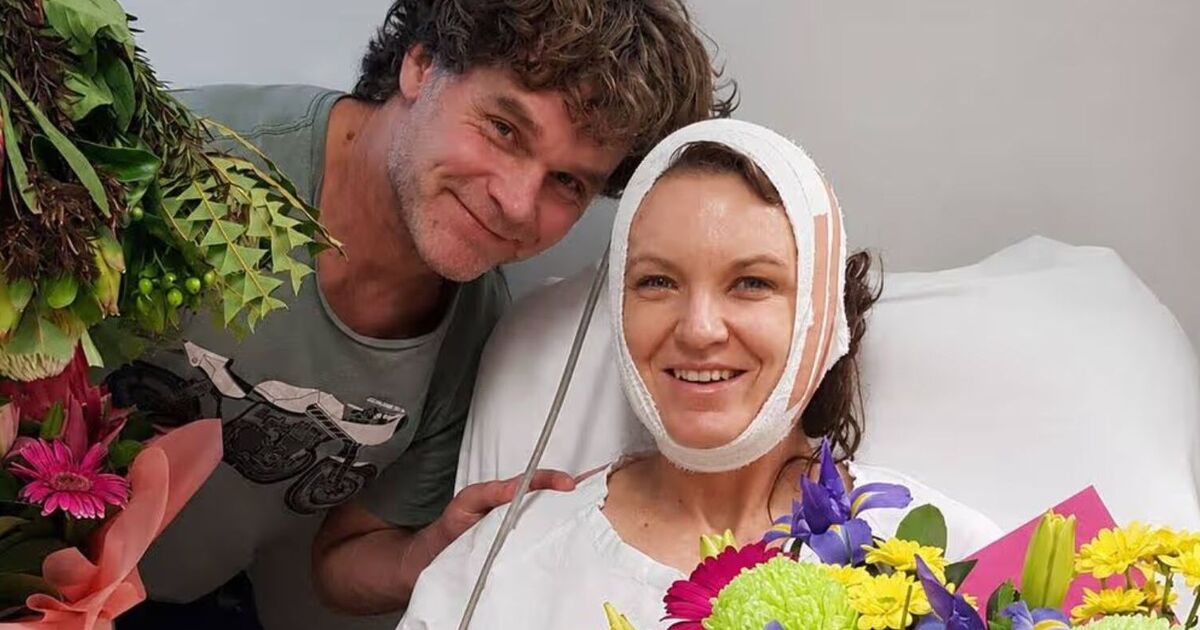
Dr Pia Winberg lost 30% of her scalp in an industrial incident (Image: Jam Press/PhycoHealth)
A scientist whose scalp was torn off in an industrial accident has described the terrifying ordeal, recalling how she astonishingly carried the severed scalp 200 metres to seek help. Dr Pia Winberg lost 30% of her scalp after her hair got entangled in a high-powered filtration pump at her South Coast production facility in Australia.
The 55-year-old miraculously freed herself, picked up her bloody scalp and carried it 200 metres to a nearby laboratory to ask a colleague to call an ambulance. The tragic day on February 7 2019, saw the marine scientist lose two and a half litres of blood at the scene with ambulance crews attempting to stabilise her for hours before she was airlifted to Sydney’s St George Hospital. Plastic surgeon Adrian Sjarif led a surgical team that operated on her for approximately six hours.
Read more: Prince Harry and Meghan torn to shreds for ‘deliberate’ King Charles stunt
Read more: Devastated top rugby star, 30, diagnosed with motor neurone disease
Dr Winberg, who has no recollection of carrying her ripped bodypart in her hands, has now recounted the terrifying day.
“I was wearing my factory cap, protective eyewear and hearing protection,” Pia, from Narrawallee, Australia, told creatorzine.com. “I assumed that the small ball grip at the end of the valve handle unthreaded, and rolled under the machine. Why else I would have been on my knees with my head just above floor level?
“That’s where I found myself. The next memory was a just sense of frustration, as I tried to work out why my hair felt like it was tangled in two directions in something. I brought my hands down in front of me.
“In confusion, I wondered why my hands were completely covered in red – that was when my memory stopped again. I must have managed to extract my hair, remove my scalp and its hair from the machine, and walked, holding it, 200 metres to the lab building. I opened the door and said my colleague Rachel’s name, after which my memory stops.”

The marine scientist lose two and half litres of blood (Image: Jam Press/PhycoHealth)
Rachel described Dr Winberg as eerily composed despite being soaked in blood. Dr Winberg recounted: “I turned and walked down the corridor to my office chair.
“Rachel ran after me and it was then that she could see my skull sticking out of the top of my head, and my scalp and mobile phone in my hands in my lap. She understood then that it was me who had had the accident, and she acted fast.”
Despite the extensive efforts of the surgeons, the microsurgery of her scalp was unable to be re-attached, and the 13-centimetre hole was covered with a graft from her thigh while vacuum pressure forced the tissue to bond.
Whilst she had a vacuum pump attached to her scalp, the scientist got to work by studying wound healing and believes her own seaweed-based research played a crucial role in her recovery.
The 55-year-old said: “When the dressings could be removed a week later, I went straight into using my seaweed gel moisturiser across the whole mesh graft site, and it healed so well that I say I had baby skin across my head and not a single scar from the mesh skin pattern.
“Not that having a baby’s bottom effect across my head was ideal, but it was still amazing. I kept using the cream, until a year later, because skin remodelling takes as long as that after trauma.”
The following year saw the brave scientist endure six additional reconstructive operations as surgeons progressively stretched her remaining scalp tissue over her skull using inflatable expanders topped up with saline on a weekly basis.

Dr Winberg has endured several reconstructive surgeries (Image: Jam Press/PhycoHealth)
She said: “They approached this by implanting expander bags under the side patch of hair and scalp tissue that remained on one side. These bags were expanded to stretch the scalp with hair on it slowly, by injecting 10ml of saline each week.
“After the bag was filled to a litre of water and I had a giant hair balloon on the side of my head, a fourth surgery could remove the balloon, detach 90% of the baby skin graft tissue, and extend the stretched, real, scalp tissue with hair over to the other side of my skull to reattach once again.
“After this, another two surgeries tidied it up, and today there is just one four centimetre patch of baby skin, thigh graft tissue on my skull. The rest is extended true scalp with my own hair, thinned a bit, but with feeling and better thickness than thigh skin, which was thin and with no nerves or sensation.”
Dr Winberg’ says the map of her own head had to be redrawn and that she “could feel” her “brain learning again”.
She said: “Before the accident, I thought of the scalp mainly as the place that held hair. After losing mine, I learned that the scalp is far more than that. It’s a living, sensory, vascular organ wrapped over the skull, thick, richly innervated, full of hair follicles, blood vessels, glands and connective tissue.
“The scalp helps protect the skull and brain, regulates heat, senses touch and temperature, and anchor the hair that shields us from sun, cold and environmental exposure. Losing my scalp changed more than my appearance. I experienced vertigo and a strange disconnection from the top of my own head.
“Hair movement activates nerve endings around the follicle, making hair-covered skin sensitive to light touch, brushing, air movement and subtle environmental contact. I had to relearn touch, pressure and position across my skull.
“The map of my head had been redrawn. I could feel my brain learning where I was again.”

Dr Winberg has used her own research to aid her recovery (Image: Jam Press/PhycoHealth)
The scientist was quick to point to how her injury could help with her own research with her own studies now focusing on SXRG84, a seaweed-derived gel that seems to replicate molecules involved in human tissue repair, hydration and collagen production.
Researchers at her firm PhycoHealth are now exploring whether the marine gel might assist burns patients, persistent wounds and tissue damaged by chemotherapy.
She said: “I became, unwillingly, a patient inside the very clinical world I was trying to help and experiencing the challenge from the frontline. I saw the brilliance of surgeons and emergency clinicians, but also the limits of what medicine currently has available when large areas of complex tissue are lost.
“A split-skin graft can save life and cover bone, but it does not replace full scalp tissue, hair follicles, thickness, sensation, glands, elasticity or the original sensory map of the body. That’s why our research now matters to me in a completely different way.
“We’re investigating how these marine glycans can support skin repair, collagen protection, inflammation control, microbiome balance and even 3D-printed full-thickness skin models. What began as ecological science, cultivating seaweed to transform waste nutrients into valuable biology, became deeply personal.”