Tesla is finally launching the Cybercab — let’s hope it’s ready
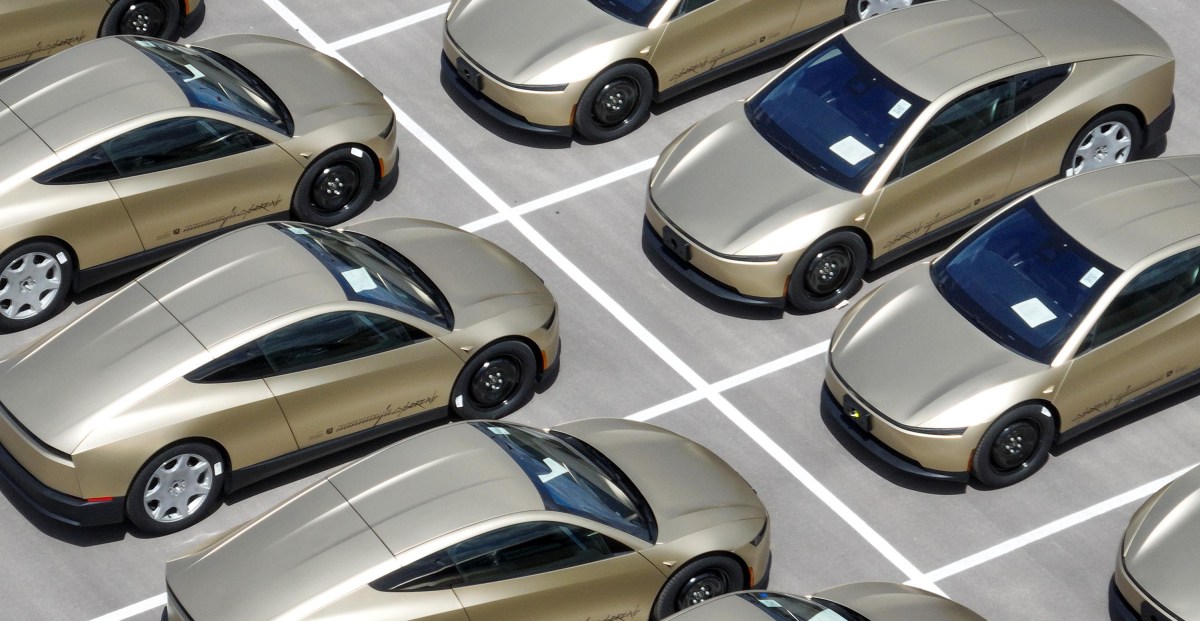
The Tesla Cybercab, that golden two-seater central to Elon Musk’s robo-supremacist ambitions, is finally nearing it’s public launch. Whether or not the no-steering wheel and no-pedal vehicle is actually ready for public roads, let alone customers, remains very much in doubt.
According to The Information, Tesla is planning a public launch of the Cybercab in Austin, Texas, as soon as this month. The driverless vehicle has been popping up around the country, although often with a steering wheel and pedals, as employees are continuing to gather data. Tesla employees have been testing the fully driverless version on private roads around the company’s campus since July. And it recently completed a training with first responders in Austin, teaching them how to move the vehicles in the event of an emergency, Brad Cesak, a spokesperson for the city of Austin, confirmed.
Tesla’s Robotaxi account on X recently confirmed that a “Cybercab launch event” was imminent, inviting followers to take a ride in the company’s Model Y robotaxis in order to win a ticket.
But given what we know about Tesla’s autonomous driving project so far, the Cybercab could be heading for trouble. The Cybercab operates using Tesla’s Full Self-Driving (Supervised) software, which the company claims is significantly safer than human driving. However, independent safety experts and federal regulators have called into question this claim, noting that FSD requires constant driver oversight and remains under active investigation by the National Highway Traffic Safety Administration for traffic compliance failures.
Over a year after its launch, Tesla’s Robotaxi service still uses human safety monitors in some markets. But the Cybercab is designed to operate without any human intervention, which removes one layer of safety on which Tesla can fall back. The company says it employs remote operators who can take control in case of an emergency, but experts question whether signal strength and latency could hamper reactions, especially during incidents in which every second counts. Tesla recently started adding Starlink to its Cybercabs to address this question of connectivity.
There’s also the question of data, and whether Tesla has enough of the right kind. For years, Tesla was assumed to have an advantage in the race to put driverless cars on the road, thanks to the millions of vehicles on the road, passively gathering data to help train its autonomous driving models. But the Cybercab is a different type of vehicle with a unique platform that requires its own specialized data, Musk said during an earnings call in July.
“We need to accumulate driving data that is specific to the Cybercab before we can put a lot of them on the road,” he said.
Once considered to be a leader in data collection, Tesla may actually be a laggard. During that same earnings call, Ashok Elluswamy, the company’s head of AI, said that Tesla’s unsupervised robotaxis have driven 380,000 miles across six cities in two different states. Waymo, which has operated a commercial robotaxi service since 2020, has driven over 220 million fully driverless miles on public roads — or about 579 times more miles than Tesla.
Tesla uses a mix of unsupervised and supervised vehicles as part of its current Robotaxi fleet, but that ratio appears to be in a constant state of flux. According to the crowdsourced Robotaxi Tracker, the company was operating 16 unsupervised vehicles in Austin, four in Dallas, and one in Houston.
Tesla also hasn’t submitted its safety claims for independent analysis, instead relying on self-published statistics while actively working to block public scrutiny of the data it’s required to provide to federal regulators. Meanwhile, Waymo has published several studies in peer-reviewed journals. Recently, the nonprofit Insurance Institute for Highway Safety examined Waymo’s first 50 million miles of fully autonomous driving across multiple cities and concluded that its crash rates were significantly lower than those of human drivers.
The Cybercab launch comes at an odd moment for Tesla. Whereas other vehicle launches have excited Tesla’s many fans with their cutting-edge technology, the Cybercab remains a bit of a curiosity. It’s the lightest, most efficient electric vehicle Tesla has ever produced. But it’s unclear whether the technology powering it is adequate for commercial operations. Still, it’s more like the Tesla Semi than the Model Y or Cybertruck, insofar as it seems destined for commercial service and not personal ownership — despite Musk’s claims that you will eventually be able to buy one.
The Cybercab’s lack of traditional controls means it will be hamstrung by federal safety rules that require things like pedals and side mirrors before they can be sold to the public. That said, if Tesla were to receive an exemption from federal regulators, allowing the company to produce and sell thousands of Cybercabs, that calculus could change. Amazon’s Zoox recently received permission to begin charging for rides in its purpose-built robotaxi. Whether Tesla is also seeking a similar exemption is unknown.
What is known is that Tesla is going to roll out the Cybercab later this month, as if it’s really ready for primetime. But lingering safety questions, as well as the limited nature of Tesla’s Robotaxi service, suggests the Cybercab may still have a long road ahead of it.