The unsung hero of England’s 1966 World Cup team | Football | Sport

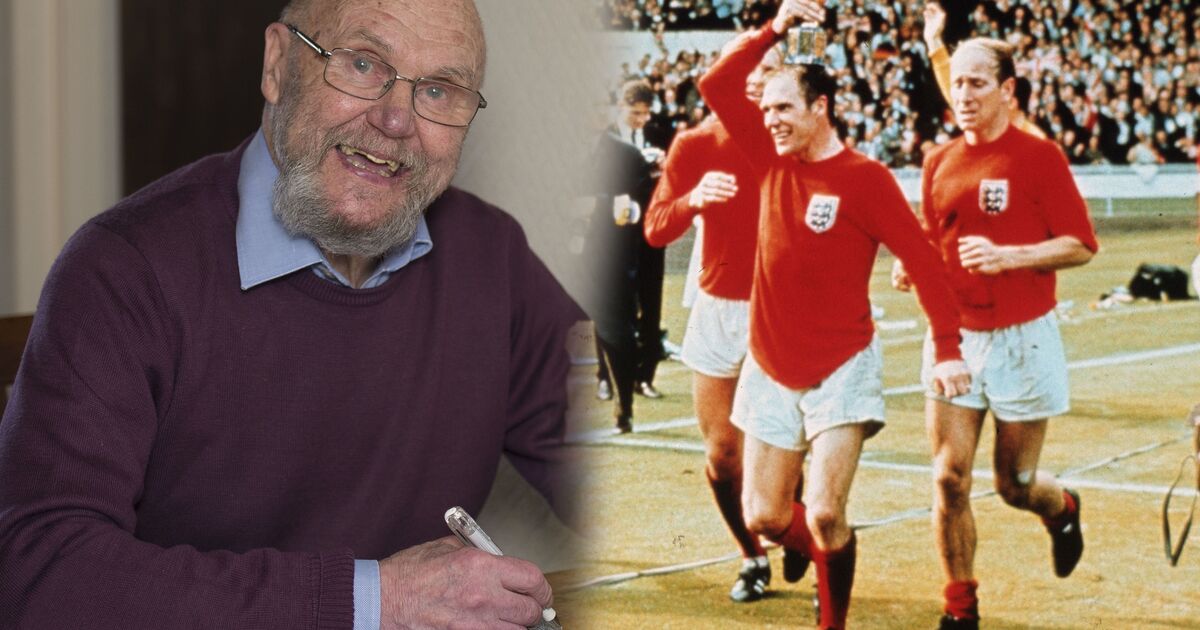
Ray Wilson, left, and holding the Jules Rimet trophy after England’s 1966 win, right (Image: Getty)
They were the boys of 1966, a select group of men who became synonymous with sporting glory and a moment in time when England’s footballers, for once, really did rule the waves. Geoff Hurst, Bobby Moore, Gordon Banks, Martin Peters, the Charlton brothers, Nobby Stiles, George Cohen, Alan Ball, Roger Hunt, names etched into the English national consciousness through winning the coveted World Cup 60 long years ago.
Well, all of them except for one. What’s more, that’s just the way he liked it. Despite making 63 appearances for his country over the course of eight years and playing in all six of England’s matches at the 1966 World Cup finals, Ray Wilson remains the forgotten member of the team that captured the Jules Rimet trophy.
Part of that is down to the position he played in – left-back in defence will never be as sexy as, say, striker or midfielder. Wilson also spent much of his career at Huddersfield Town, then in the second tier of English football, when the majority of his international peers were appearing in the top flight for the likes of Manchester United and West Ham.
But then Wilson was never one for chasing the limelight, either as a player or after hanging up his boots. Whereas other members of the 1966 team dabbled in managing pubs and/or football clubs, with varying degrees of success, Wilson became an undertaker. Rather than attending football matches and basking in the adulation that would’ve come his way from the packed terraces, he preferred the solitude of the countryside in that part of Yorkshire familiar to viewers of the TV show Last of the Summer Wine, the kind of landscape where a man can lose himself both physically and in his own thoughts.

Ray Wilson at work as a undertaker in June 1974 (Image: Mirrorpix)
“I’ve always been around the moors area, apart from those few years at Everton,” Wilson once said with a nod to the five seasons he spent playing on the blue side of Liverpool, during which he won an FA Cup winner’s medal two months prior to becoming a World Cup winner with England. “If you ask me what’s my passion now, it’s going for long walks. I don’t miss football. In fact, I honestly can’t remember the last time I went to a match.”
Born in Derbyshire in 1934, Wilson, who died in 2018 aged 83, had it anything but easy growing up. His father, a miner, had been forced to stop work after suffering an injury below ground. Following his mother’s death when he was 15, Wilson got a job in a railway wagon repair yard, playing amateur football during his spare time. No sooner had Huddersfield Town rescued him from the real world, he was called up for National Service, the standardised form of peacetime conscription introduced in 1947 for all able-bodied British men between the ages of 18 and 30.
“After initial training, they gave us two choices of where we would like to be posted,” Wilson recalled. “I put England first, and England second. So they sent me to Egypt! When I got back, hardly anyone remembered me.”
That didn’t stop Wilson breaking into the first team at Huddersfield, where he made 283 appearances between 1955 and 1964, at the same time establishing himself as England’s regular left-back. When Everton came calling for his services in a transfer deal worth £40,000, no small amount in the mid-1960s, the Yorkshire club simply couldn’t refuse.
By the time 1966 came around Wilson was the best left-back in the country bar none and England manager Alf Ramsey’s automatic choice for that position at the World Cup, which took place on home soil, with the final being played atWembley Stadium.
Having barely put a foot wrong in an international match over the years, it was Wilson’s error in the 13th minute of the final which allowed West Germany to take the lead through Helmut Haller. Fortunately his slip didn’t prove costly as England went on to prevail 4-2 after extra-time, with Geoff Hurst scoring a famous hat-trick.
“Every time I see that weak header of mine out to Haller on TV, I think, ‘Why do I keep doing that?’” Wilson once wryly observed. Those England internationals sat in the stands that day who hadn’t been selected to play were equally surprised by his uncharacteristic blunder. As goalkeeper Peter Bonetti of Chelsea once told me: “I don’t think any of us knew he was capable of making a mistake.”
“As a player, he really was superb,” recalled Gordon Banks, the man who kept Bonetti out of England’s team in 1966. “He wasn’t a big, strapping guy, but he was so quick. He was a world-class player without any question. There were players we just couldn’t do without, they were terrific players, and he was one of them.”

Ray Wilson walks out on to the pitch at Wembley followed by Jimmy Greaves and Bobby Moore (Image: Mirrorpix)
Wilson continued performing at the highest level for England and Everton until the late 1960s when injury brought the curtain down on his playing career. By that time he was in his mid-thirties and ready for something completely different.
“Being in football for ever was not what I wanted out of life,” he admitted. “When I left Everton I had a few games for Oldham and then a spell as caretaker manager at Bradford, but it just didn’t have the right feeling for me.
“My father-in-law had an undertaking business, and earlier I’d worked there a bit in the summer to make up my wages at Huddersfield. When I stopped playing I told him I wanted to learn the business properly, and so I took all the necessary exams – hard work when you’re about 40!”
“Back then there was no financial security in football, not even if you were a World Cup winner,” says Neil Wilson, one of Ray’s two children from his 62-year marriage to wife Pat. “They didn’t sign big contracts like they do today. They signed a new contract every six, eight or 12 months and if something happened you could be out of work all of a sudden with very little in the way of savings to keepyou afloat.
“My dad decided he had too much to lose, and with my granddad being on the verge of retiring, it seemed like the perfect time for him to take over the business. It was a job he took extremely seriously. At the end of the day you’re dealing with people who are grieving. You want everything to be right for them, and for the person who’s died to receive a fitting send-off. And he would do that.”

World Cup veteran Ray Wilson with wife Pat two years before his death (Image: Daily Mirror)
Wilson retired for the second time when he was 62, after which his life came to revolve around family, those long moorland walks and playing dominoes with his closest friends over a pint or two, usually at The Griffin Inn in the West Yorkshire villageof Barkisland.
As with many retired footballers, including various members of England’s World Cup-winning team, the spectre of Alzheimer’s cast its shadow over his final years, during which Wilson displayed a talent for drawing pictures which had lain dormant until the onset of the disease.
However, his family have always stopped short of blaming the so-called beautiful game for Wilson’s neurological decline.
“My mum was of the opinion that if you look at life now, an awful lot of people are affected by it or have passed away with it who never headed a ball in their lives,” adds Neil Wilson. “I think it’s one of those things where, yes, you could say playing football contributed, but then you could also say we’re all living longer now than we used to.
“It’s a funny one for me because football was so much a part of what people knew him for. He was somebody who came from an ordinary background, did something he really enjoyed for the love of it, not for the money, was loyal to the clubs that he played for, and gave his life to football before going on to enjoy a second life away from it.
“Dad had a tough upbringing, and football gave him the opportunity to escape that. When you look at it that way it was football that made him, not the other way round, and I don’t think he’d have had it any other way.”