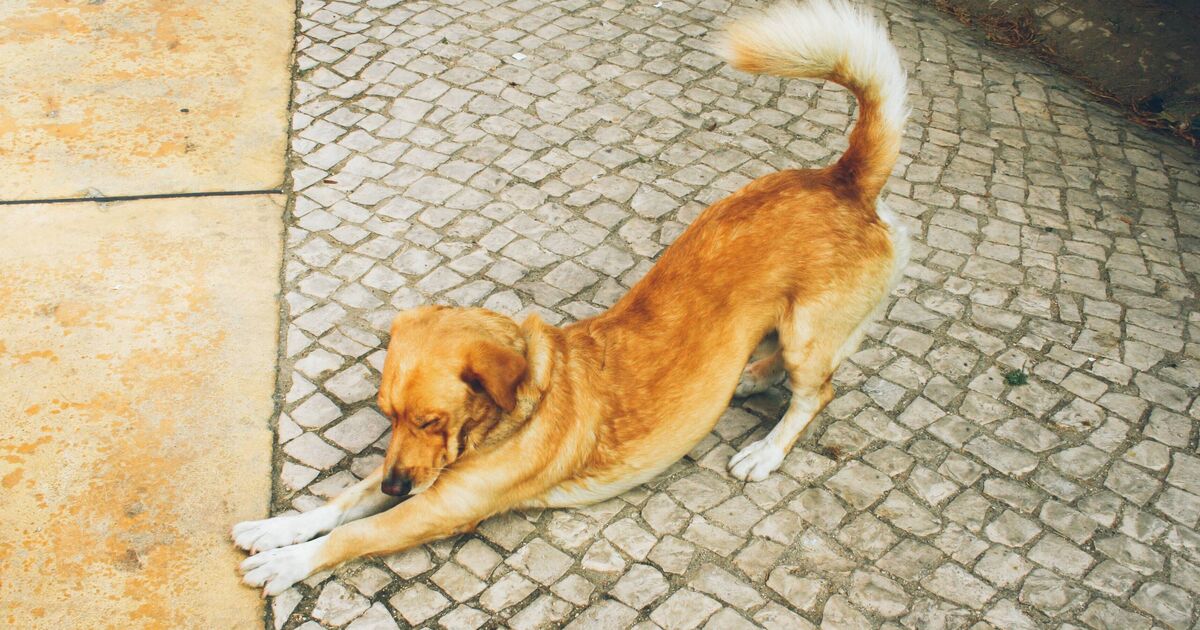
Vet shares sweet reason dogs do full-body stretch when you come home

Vets have explained the exact reason dogs stretch when they see you (Image: Getty Images)
Does your dog stretch the instant you walk through the front door? Contrary to popular belief, it’s not necessarily down to them having just woken up or experiencing a touch of boredom. Actually, it’s a reassuring indication that owners should “take as a compliment”.
Comprehending our pets can occasionally prove tricky given their inability to speak to us directly. Dogs, though, utilise their entire bodies to convey their feelings.
Consequently, grasping your dog’s body language can assist you in determining whether they’re feeling self-assured, calm, or nervous and unsettled. Once you identify these cues, you’ll be far better placed to work out what they’re attempting to tell you.
According to Dr Alex Crow, Chief Veterinary Officer at The Net Vet, when your dog welcomes you with “front legs out, hips up, tail wagging,” they’re attempting to relay something specific.
“It’s not just coincidence. It’s called a greeting stretch,” he revealed on TikTok. “It’s more than just shaking off a nap. It’s a sign that your dog feels safe, relaxed and happy that you’re home,” the vet continued.
Dr Alex also noted that dogs may stretch to “loosen up stiff muscles”, yet if they perform it straight away when you return, it’s “intentional”. He went on to say: “It’s their version of a calm, friendly hello and if you’ve ever reacted to it with praise, you’ve probably reinforced it without realising.”
However, it’s crucial to bear in mind that “not all stretches are about affection”. If their belly is positioned low to the ground, it “could be a sign of discomfort or pain”, in which case owners should take note.
Dr Alex recommends to “keep an eye” on the behaviour, and to get in touch with your vet if concerns arise, stating: “Most of the time though it’s just your dog’s way of saying hello.”
Within the comments section, one dog owner revealed: “I always thought it was because they knew I was about to take them for a walk.”
Another chimed in: “Yes! Every morning when I go downstairs, he is laying in his bed waiting for me and when I open the door he jumps up and does the big stretch on my foot! Gets lots of scratches then picked up for cuddles and kisses. Boston Terrier.”
A third person noted: “The ‘big stretch’ must be an international thing. We all say that in our native language, right? At least I do.”
Other users also pointed out that cats display comparable behaviour.
Hill’s Pet clarifies that animals, much like people, need to stretch their muscles from time to time. They may need a proper stretch following a lengthy rest or deploy it as a playful signal.
Animals might also stretch when they’re lacking stimulation, frequently combined with attention-seeking. In these instances, taking them for a stroll or engaging in playtime indoors or outside can prove helpful. That said, stretching could also be a sign of a pulled muscle or joint pain, with the animal stretching the affected area in an attempt to ease discomfort. Should your pet appear to focus on stretching a particular area more than is typical, and seems sluggish when getting up and moving, this could point towards arthritis or joint pain, and a visit to the vet would be advisable.
Abdominal problems may also be connected to certain stretching behaviours in dogs. If a dog is suffering from abdominal pain, it may stretch with its rear end raised while its front end is lowered flat to the ground. The animal might hold this position for a prolonged period, frequently when other dogs are not around.
You may also notice the dog whimpering or showing reluctance to be touched. Should they stretch or arch their back into a tucked-up posture, this too could be an indicator of abdominal pain, which should be examined by a vet without delay.