World’s longest tunnel to stretch 76 miles and cut 8-hour journey to 40 minutes | World | News

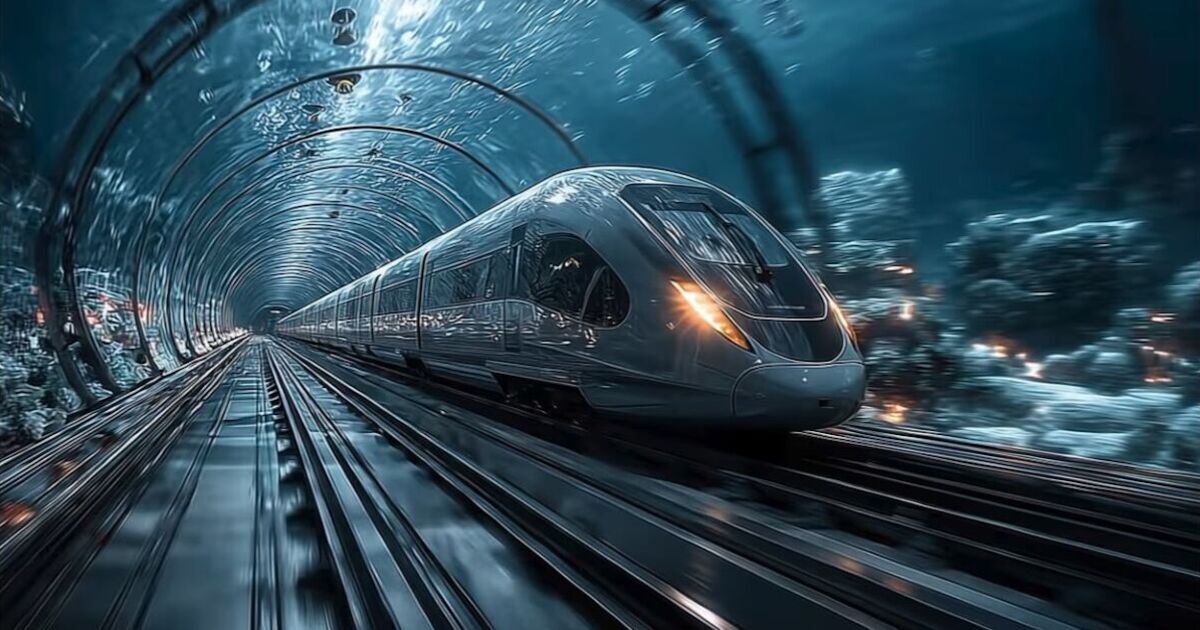
The trains will run at unprecedented speeds (Image: AI-generated)
A groundbreaking undersea tunnel costing £20billion could cut an eight-hour journey to merely 40 minutes.
The proposed Bohai Strait Tunnel in China will traverse multiple fault zones along its 123km (76-mile) length, with planners pledging to deploy cutting-edge earthquake-resistant technology to prevent catastrophe. The blueprint features longitudinal ventilation shafts to maintain air quality throughout the enormous distance.
Additionally, there are numerous cross-passages connecting the two parallel tunnels, which are designed to run approximately 80m beneath the seabed. The engineers have also incorporated several hundred emergency refuge zones, essential for evacuations in a 123-km tunnel where fire or flooding could prove disastrous.
The current estimated budget for the pioneering scheme stands at £20billion, and while no definitive completion date has been confirmed, a Chinese government official indicated in 2018 that authorities were keen to commence the project “as soon as possible.”
Once finished, the tunnel will eclipse all existing competitors. The 31-mile (49.6 km) Channel Tunnel was initially conceived during the Napoleonic Era but wasn’t completed until 1993. Japan’s 53.85-kilometre (33.5-mile) Seikan Tunnel currently holds the record as the world’s longest tunnel running beneath a body of water, with an underwater section spanning 23.3 km (14.5 miles).

The tunnel will be far longer than the Channel Tunnel (Image: Getty)
Trains on the Bohai Strait Tunnel are expected to reach speeds exceeding 150mph, cutting travel time between the cities of Dalian and Yantai by almost 90%. They will surpass Eurostar trains, which only manage 100mph when passing through the Channel Tunnel.
A staggering 56 miles of the tunnel would sit beneath the water, exceeding the combined lengths of the Channel Tunnel and the submerged section of the Seikan Tunnel.
This extraordinarily ambitious undertaking is anticipated to take between 10 and 15 years to complete. By comparison, the Channel Tunnel took approximately six years to finish once construction finally began. The inaugural train through the tunnel would likely make its journey sometime in the late 2030s or beyond.
The cities at either end of the tunnel are vital industrial powerhouses. Dalian has evolved from a major port into a prominent financial, shipping and logistics hub for East Asia.
Meanwhile, Yantai, traditionally renowned for its fruit growing, has recently experienced considerable expansion across petrochemicals, automotive manufacturing, electronics, pharmaceuticals and cutting-edge technology sectors.
Currently, the fastest connection between the two cities is the Bohai Train Ferry, which takes approximately eight hours to cross the strait.

The planned route will slash journey times (Image: wikipedia)
By dramatically reducing journey times between the two cities, Chinese officials hope to further bolster their burgeoning economic output. A government spokesperson confirmed in 2018 that authorities were keen to get the project under way “as soon as possible.” Lu Dadao, from the Chinese Academy of Sciences, told reporters that a tunnel beneath the Bohai Sea would transform transport links throughout China. They said: “By avoiding the hubs in Beijing and Tianjin it would relieve pressure on railways between Beijing and Tianjin, Beijing and Shanghai, and even Beijing and Guangzhou.”
Du Yanliang, from the Chinese Academy of Engineering Sciences, revealed that the tunnel would additionally strengthen connections between the north-east’s longstanding industrial heartlands, the Bohai economic zone and the Yangtze delta region. The project has not been without controversy, however, with environmental campaigners pointing out that the area is teeming with wildlife, most notably acting as a vital habitat and breeding ground for the spotted seal, a Class 2 protected species.
Several zones within the proposed construction area have been earmarked as potential sites for nature reserves.
Sun Fenghua from the Chinese Academy of Sciences has stressed the necessity of “serious research into all issues associated with construction of the tunnel… We must not proceed until these questions are fully understood.”