The Dead Sea Scrolls’ darkest Biblical mystery finally unlocked | History | News
A mysterious metal scroll discovered among the Dead Sea Scrolls more than seven decades ago has sparked a bold new theory connecting it to one of the most turbulent and bloody chapters in ancient Jewish history.
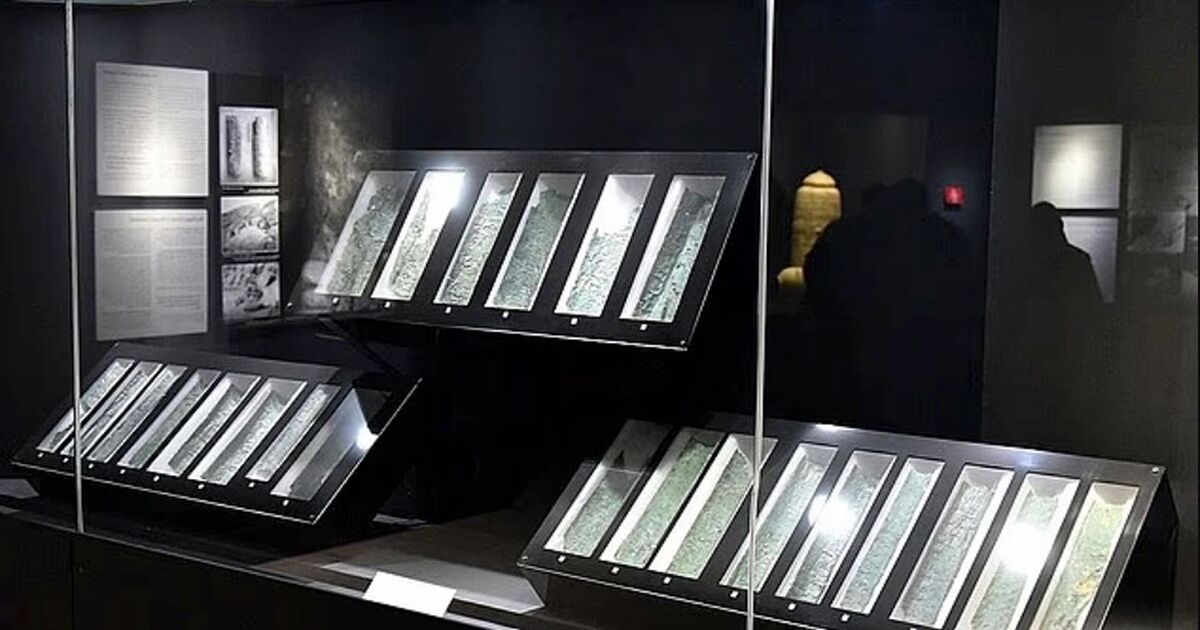
Every other scroll in the collection was inscribed on parchment or papyrus, its contents drawn from scripture or religious tradition. The Copper Scroll broke every convention: hammered into metal sheets and, by all appearances, created with no intention of ever being read again.
Some researchers believe it once documented sacred wealth belonging to a priestly sect that was convinced it was living through the biblical “End of Days,” on the eve of an apocalyptic confrontation between good and evil.
What is the Copper Scroll?
The Copper Scroll was unearthed in 1952 inside Cave 3Q, near the ancient settlement of Qumran on the western shore of the Dead Sea. Researchers recognised immediately that it bore no resemblance to any other scroll in the collection.
Where the broader archive contained scripture, religious commentary and apocalyptic writings, the Copper Scroll offered something far stranger: a cryptic inventory of buried gold and silver hidden at locations across the ancient Holy Land, described through vague references to tombs, cisterns, stairways and buried containers.
The scroll contains 64 such entries, the majority impossible to verify. Translator Józef Tadeusz Milik rendered one as: “At Khorrebeh, situated in the valley of Achor below the steps leading to the east, [dig] forty cubits: a coffer [full] of money, the sum of which is the weight of seventeen talents.” Another reads: “In the funerary monument of Ben Rabbah, of Beit Shalisha: 100 ingots of gold.”
Generations of treasure hunters and academics have gone looking, and come away empty-handed every time.
What do experts think the Copper Scroll describes?
For many years, the dominant theory held that the scroll recorded treasure hidden before the Roman destruction of Jerusalem and the Second Temple in 70 AD, reports the Daily Mail. Some scholars went further, suggesting the entries could point to missing Temple treasures that escaped Roman plunder, among them the sacred menorah, which the Romans famously carried off and later immortalised in relief on the Arch of Titus in Rome.
Now archaeologist Shimon Gibson of the University of North Carolina at Charlotte has put forward a striking alternative. Publishing a new interpretation in March, Gibson argued that the scroll may not be a treasure map at all, but a covert record connected to the Bar Kokhba revolt, a fierce Jewish uprising against Roman rule that erupted between 132 and 136 AD.
What is the Bar Kokhba revolt theory?
Gibson contends that the valuables listed in the scroll may represent funds and contributions secretly gathered to bankroll the rebellion. The revolt was led by Simon bar Kokhba, a figure whom many Jews of the era regarded as a potential messianic deliverer, destined to defeat Rome and restore Jewish sovereignty over Jerusalem. It was sparked by the emperor Hadrian’s plans to impose restrictions on Jewish practice and construct a Roman colonial city, Aelia Capitolina, on the ruins of Jerusalem.
It ended in ruin. Roman forces suppressed the rebellion with overwhelming brutality, leaving hundreds of thousands dead and Jewish life across the region shattered. The violent era has long been associated with apocalyptic expectations and a widespread belief in imminent divine intervention, a climate of thought that Gibson believes may have shaped the creation of the scroll itself.
He also cast doubt on the rival Temple treasure theory, pointing out that if Jews had successfully concealed the Temple’s most precious objects before the Roman invasion, it would be difficult to explain how the menorah ended up in Roman hands at all.
What did experts say about the new Copper Scroll theory?
Ancient Judaism expert Yonatan Adler of Ariel University told the Israeli publication Haaretz that Gibson’s hypothesis was “intriguing,” noting that enigmatic finds of this kind encourage scholars to think “outside of the box.” He added: “Even if we still lack a ‘smoking gun,’ novel and well-argued hypotheses of this kind are what move the inquiry forward.”
As part of his research, Gibson joined forces with fellow scholar Joan Taylor to make a fresh visit to Cave 3Q, working through original documentation from when the scroll was first brought to light in 1952. Gibson said the team was able to identify the precise spot within the cave where the Copper Scroll had originally been concealed.
Why was the Copper Scroll made of metal?
Copper is an unforgiving material — unroll it too many times and it shatters. Gibson takes this as evidence that the scroll was never meant to be consulted in any routine way. Instead, he suggests it was created as a permanent hidden record, one intended only for a small number of trusted individuals.
More than 70 years after its discovery, the Copper Scroll continues to resist a definitive explanation, a strange and singular artefact that hints at hidden treasure, armed rebellion and the final, desperate days of ancient Judea.